Wield the Wyrd Sword!

So we’ve smashed through the main funding goal, and last night I threw up some stretch goals to see us through to the end of the campaign on Tuesday, 19th May.

Currently, funding is a Quickstart, which includes an adventure and just enough rules to teach you how to play and run it.

Backers will get this starter module in both PDF and POD formats, exclusive to the campaign. It will not be available in print at general release.

Here’s the pitch of the adventure.

One of the Realm’s legendary founders, Queen Assure, left her famous Green Sword in a stone that can be found in the woods just outside of the village of Imping by Green Wood.

Every year, there’s a race there and back to the Sword in the Stone, to win a pot of gold generously donated by a local Merchant.

As well as winning the race, could your team contain the one who pulls the Sword in the Stone and inherits the Wyrd of the Founder?

Is there any truth in the rumours running wild that a Demon of the Warp is abroad in the wood?

The adventure introduces the Game Moderator and the players to both the rules and the setting, exploring the game’s theme, Warp vs Wyrd, straight away. The quickstart also contains six premade characters, so you can pick up and play.

Paul Tomes did this lovely cover for it.

A ghostly woman in a dark wood

How I Wrote Wyrd Sword

This has been a passion project that I’ve been working on for a good two years on and off, since the reality of having one of my all time favourite roleplaying game systems, Chaosium’s Basic Roleplaying, became available via the ORC license in the form of the Basic Roleplaying Universal Game Engine (BRUGE) book. It was a somewhat obsessive itch that I could not help but scratch.

NEWT BRP

My first go at this was a quick hacking project I undertook in my Easter break of 2024. Take BRUGE and can if I could do a quick fantasy based game from its text. This very personal version (hence the name) was a very rough edit down, cutting and pasting, and writing a bit of text to glue it together.

So did I get a quick Fantasy BRP out of it? Sort of, with the following caveats.

  • I was a bit unhappy with the “normal folks” professions. I know this is a big thing in Call of Cthulhu, but honestly, professions like Farmer and Slave just don’t do it for me.
  • I chose Magic out of the many Powers systems for NEWT BRP, and it has gaps as a one sized fits all magic system that does what I want it to do. BRUGE has about 33 spells while the current Wyrd Sword draft has 40+ spells.
  • It was still burdened by systems from the 70s like the Resistance Table that don’t meet modern expectations for playability.
  • In my opinion, the system, despite being edited down, was still a bit bloated for what is meant to be a “Basic” role-playing system.

So once Easter was over, I put it to one side and got on with other D101 Games projects.

The Inspiration for Wyrd Sword

Using points of concern about the NEWT BRP as a starting point, I took the draft along with me on my summer 2024 holiday.

The aim this time was to produce….well initially I wasn’t sure what? Then inspiration struck!

My gaming youth in the late 80s was made up of a heady mix of AD&D 1st edition, which then advanced into playing the Games Workshop editions of RuneQuest, Stormbringer and Call of Cthulhu, which for the time were lavishly illustrated colour hardbacks.

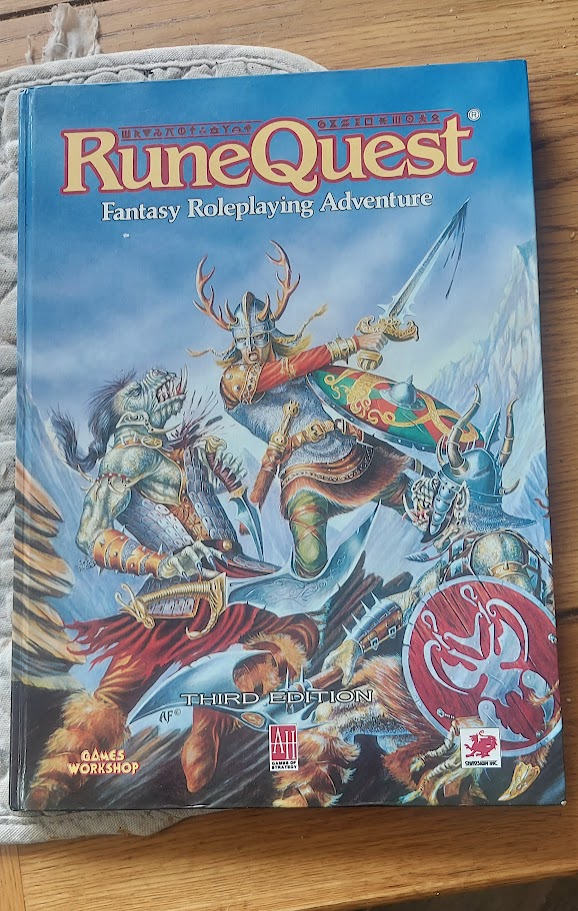
Here’s the RQ book, equivalent I believe is Avalon Hills Standard RQ box set.

Games Workshop's RuneQuest 3 book

I loved this book when it came out in the late 80s. It was my first real entry into the BRPverse, and even though it was a very short 100 or so pages, it was enough to inspire me to run a campaign in a setting of my own devising (since the Glorantha was not included in this book) for a good six to nine months.

So what I did during these Summer Holiday Sessions was to expand on what I did and move it towards something I could publish. The following blog post expands on this. Note the system was called Legacy then, before I realised that there was at least three other rpg games called that!

The Realm and Borderlands playtest

So eventually, I had a playtest worthy draft and decided to take the plunge with my friendly daytime online players, Adrian and Tony. Both were enthusiastic to see what I had come up with, as they were both fans of RQ 3 back in the 80s/90s. We played using Role VTT (playrole.com) the sheets for which will be released along with the book.

 Three bearded men, of various beard lengths, playing the Basic Roleplaying Game Wyrd Sword online using Role Virtual Table Top
Playing Wyrd Sword with my daytime online group, from top left myself, Adrian and Tony.

Lots of rough edges were filed off. A overly complex Flexible Magic system was sacked off in favour of the Magic system with tweaks to make it more flexible, and I wrote a Martial Arts system, as power system for Tony’s warrior, so they weren’t outshone by Adrian’s Magician every combat. It brought balance to the game, and I’ve found the duo work together in combat smoothly now, which is inspiring.

Big one for me as the GM is my proposed Sandbox, or Toybox, framework for adventures works! No big meandering plotlines, just quick action, using reusable Non-Player Characters, Locations and a system of Quests. A bit like computer RPGs like Fallout and even Borderlands.

Also it turns out its a very different game to OpenQuest (phew!). OpenQuest is a big, rather epic fantasy game that explores how characters relate to the supernatural world and the myths that surround it. While Wyrd Sword is more about the characters and them making their way in the world and becoming Legends in their own right.

The Current Game

So, where am I up to so far?

  • Mega Gaming Fun, but with moments of grit and intense focus on the characters.
  • A comprehensive array of fun character options. Four playable species, thirty fun professions, 40 plus magic spells, seven martial arts styles and as well as arms and armour, various kits of adventuring equipment for quick pick up and play character creation.
  • A streamlined version of BRP that includes modern innovations like the Wyrd point system, yet remains recognisably BRP.
  • A setting, the Realm, that is discoverable via play rather than a series of setting supplements, and can easily be reskinned to whatever fantastic style you fancy.

Who will like Wryd Sword?

  • If you are already familiar with BRP, through games like RuneQuest and Call of Cthulhu.
  • If you are a system tinkerer. BRP’s rulings break down into modules that are an easy swap in or out. Even if you don’t play Wryd Sword as written, you can easily swap in your preferred BRP rules variant or use bits from it in your own BRP games.
  • If you are a veteran of BRP who wants a game that works out of the box (That’s me)
  • If you and your players are coming from 5th Ed and want an instance of BRP that is easy to learn yet offers all the options for open play that BRP is famous for.

What’s Next?

The game is on Kickstarter from Tuesday, 5th May to Tuesday, 19th May (that’s two weeks), with minimal stretch goals and a fast and furious campaign that focuses on the book. I do have plans for if the funding goes ballistic, which adds support for the game, and celebrates its co-creating style of adventure creation, while not delaying the release of the game with me being tied up with rewrites or writing additional material. But these two weeks will be your only chance to get printed signed and sent copies, and even a nice red leatherette version of the book!

Preview of Wyrd Sword now available

Here’s a quick seven page preview of Wyrd Sword. It contains an overview of what the game is about, an example player character, and, for existing BRP and OpenQuest fans, how Wyrd Sword is different from those games.

The Kickstarter opens next week on Tuesday, 5th May. The following is a link to its page, which is currently in prelaunch mode, so you can sign up to be notified the instant that it goes live.

Annoucing SHADOW DORK!!!

I’ve thought long and hard about this, but it’s time to announce what is going to be the focus of D101 Games going forward.

Immediately effective, my new RPG SHADOW DORK! (see attached flyer for details)

SHADOW DORK, one RPG to rule them all, and in the dark Grimdark Basement, blind them!

UPDATE: This is of course, given the date it was posted, this year’s April Fools.

#ttrpg #dnd #nonemoregrimdark #AprilFools

The Ziggurat will Rise Again!

Apart from a bit of tweaking, my Oldhammer RPG hasn’t had much time dedicated to it since its initial run out at Grogmeet earlier this year (!)

So when the call for games for Grogmeet 2026 in January was issued without thinking, I hammered out the pitch to the sequel to Ziggurat of Gloom, Beneath the Ziggurat of Gloom!

“You’re only meant to blow the bloody doors off!” Head Brewer Danblain Goldtooth to Sorcerer’s Apprentice Harry Copper.

In the aftermath of the Regiment’s battle against the Goblin Horde at the Ziggurat of Gloom, the Dwarf Brewmaster of the Beddington Brewing Company reveals the real reason behind their expedition from Dwarfchester over the Painine Hills to this ancient site. It’s not to deliver the beer barrels they have been guarding to Harry Copper as the student representative of Uddersfield College of Magic. No, the barrels aren’t filled with booze, but with the finest Dwarfchester Black Powder. Harry Copper isn’t here to collect them for an end of term knees up, but as a dedicated anarchist, he intends to use his skills to blow them up and gain access to the underhalls beneath the Ziggurat. Your Regiment, renowned for exploring the Underworld, has actually been hired to uncover the mysteries that lie beneath.

“Could it be Chaos? A swarm of Ratlings? You’ll have to wait and see!
Hope its Orc’s, it’s Orcs, We all hope its Orc’s..”
Impromptu battlefield singalong by Beddington’s All Dwarf Choir, upon hearing that the underhalls are to be explored.

Grim and Dangerous is a reimagined roleplaying game inspired by the early editions of Warhammer, also known as Oldhammer. It features a simple roll-under D20 mechanic, with characters having career focuses and special abilities that distinguish them from one another. This adventure draws heavily on the White Box of Warhammer, Warhammer 1st Edition. Please note that this game is currently in development at the playtest stage.

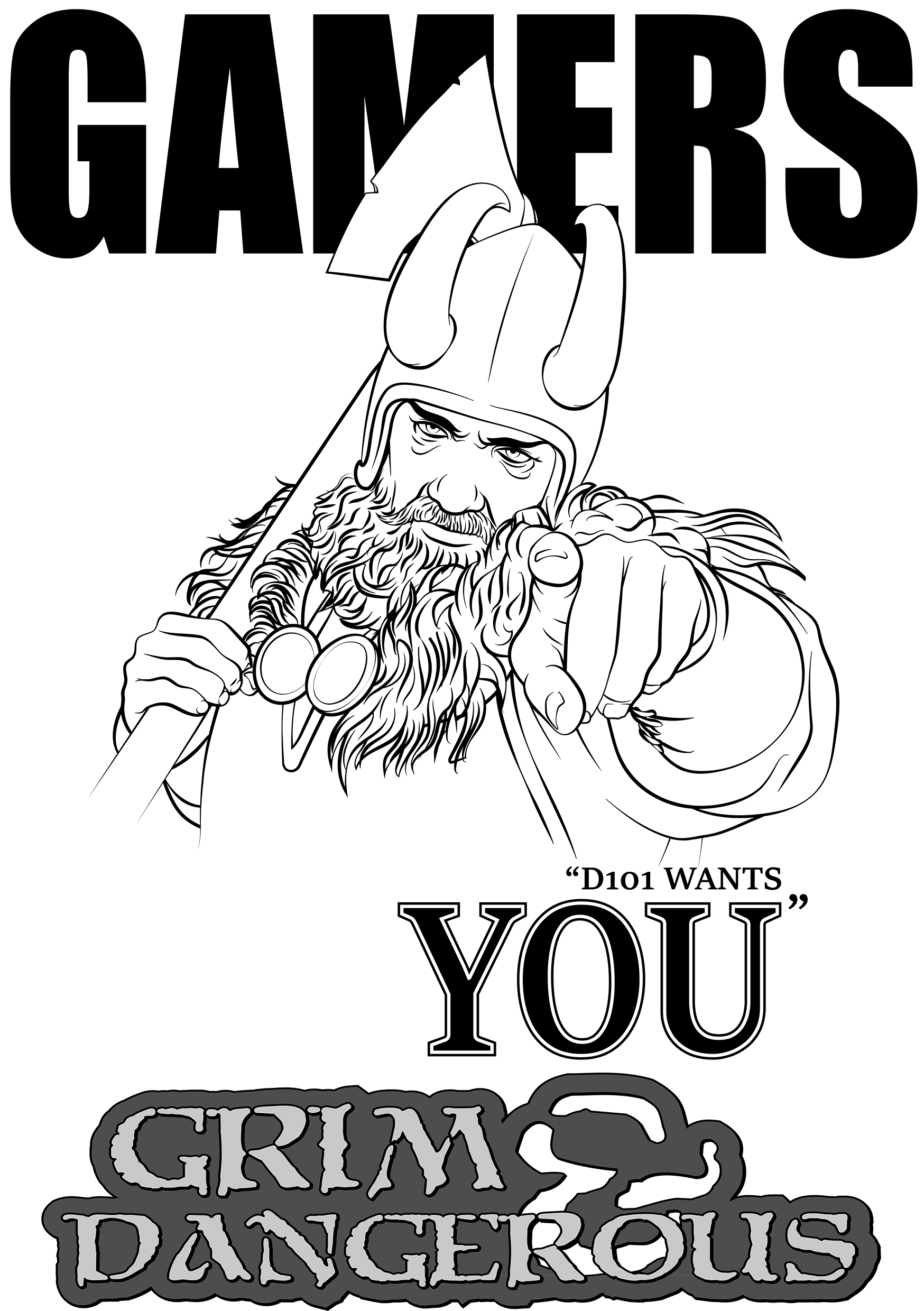
While Dan Barker is working on the cover for the current set of rules, he’s created a logo and a flyer of sorts (inspired by a very famous WWI British recruitment poster).

Dwarf pointing towards viewer, with the caption Gamers D101 Wants You,

The Shrine of Chaos and the D101 Hack

I ran my adventure, The Shrine of Chaos, using the D101 Hack, at Virtual Grogmeetish a couple of weekends ago.

The D101 Hack, in a nutshell, is a rules-light D20 class/level game that I’m developing inspired by the Black Hack/Dungeon World and other common sense rulings I’ve come across over the last decade or so. The version I was using for this game is called Fighting Old School Fantasy, inspired by 80s British D&D and Fighting Fantasy (aka BOSR), and features the familiar Test your Luck mechanic from Fighting Fantasy for Saving Throws, hence the name.

I originally planned to run the Shrine of Kollchap as written straight from What is Dungeons and Dragons?

“Many years ago, the Shrine of Kollchap flourished. Priests of Chaos made human sacrifices, and their servitors raided the lands around for new victims to satisfy the thirst of the Chaotic god. The villagers were, at first, too terrified to do anything, but at length collected a small army and appealed to the King for aid. He sent only his champion, Amaul, bearing the Sword of the Sorcerer. Together, they marched to Kollchap and drove out the priests and their allies. Amaul, however, was killed in the assault, and the sword has never been seen again. Just recently, the Priests of Chaos have begun to reoccupy Kollchap, and some villagers have been abducted. If the Sword of the Sorcerer were to be recovered, the shrine could once again be cleared out and, this time, finally destroyed.

From “”What is Dungeons and Dragons?”” the original British D&D for Dummies published by Puffin in 1982! I’ll be using the D101 Hack, my own take on rules-light OSR DnD with modern rulings (inspired by the Black Hack).”
OSR, D20, Grimdark

The four player characters were the Fighter, Thief, Magician, and Templar (= cleric). On the day, I couldn’t find the book, so I improvised the adventure, and the Shrine of Chaos was born. Also, somewhere along my ramblings, the Forest of Gloom, which riffs heavily on the old Fighting Fantasy book the Forest of Doom, got thrown into the mix.

The adventure started in Little Town (a town barely out of village size, full of little people, Halflings, Dwarfs, etc ) that forces of chaos had recently attacked. The PCs had beaten off an attack by Orcs and Goblins, earning them two Achievements in the process, allowing them to level up and gain perks. I wanted to present 2nd level characters, because as a con game I thought it would be more interesting. There were strong indications that chaos was regrouping beyond the Forest of Gloom, at the legendary Shrine of Chaos. So a concerned Mayor had a chat with the characters in the local Tavern and hired them to go to the Shrine to see if this was true. There was also the matter of the lost Sword of the Sorcerer of the hero, Amaul, lost there in a previous assault on the Shrine.

Our little adventuring party then passed through The Forest of Gloom, intending to talk to the local Wizard in residence, Garrick Greenback (aka Old Greeny). They easily made it to the centre of the wood where the Wizard’s Tower stood proudly in a clearing. Still, Old Greeny was not willing to tell them where the Shrine was unless they sorted out a band of Goblins who were trying to capture the giant Gloom Wolves, who den in the wood, for use as mounts. The Goblins were dealt with through a combination of negotiation and intimidation, and finally by trapping them in the clearing with the wolves they were trying to capture. The party left to the sounds of the mama wolves and pups having lunch. Returning to Old Greeny, he was more than happy to tell them the location of the Shrine, because they had got rid of the goblins, without indiscriminately killing the wolves.

Beyond the forest, in a blasted fen, lay the ruins of the Shrine of Chaos. A group of Hobgoblin soldiers out camped on the ruined temple, where the trapdoor entrance to the actual underground shrine was, had their leaders picked off by the Thief (we decided to make Backstab into Stealth Attack, so roll to hit with advantage and double damage did the job) and quickly routed into the night. Descending into the underground, the characters encountered a group of Zombies, which the Templar quickly turned, sending them running into the next room. Where a group of chaos cultists, dancing naked around a fire pit, were it appeared they were summoning up a chaos horror beyond a door that no man was meant to open. Turns out the Chaos Cultists were misguided Talls, the only human family from Little Town, trying to appease Chaos by venerating it. So the characters (and Zombies) quickly persuaded them to flee the scene. The Zombies shambled off into a dark archway and beyond, just in time for the sealed door to crack open, revealing the Shrine’s Champion of Chaos…an undead Amaul, resurrected by the chaos powers of the shrine, wielding the Sword of the Sorcerer! Another successful Turn Undead (despite it being a difficult one, which saw the player roll successfully below half WIS on a D20) and Amaul is fleeing before the Templar’s boldly presented Symbol of Righteousness. More “Stealth Attacks”, this time with a sword, from the Thief, and the fighter finally getting in the act, and being exceptionally lucky and rolling a critical, doing maximum damage, and Amaul didn’t stand a chance!

The characters triumphantly returned to Little Town, where they were hailed as heroes and rewarded financially. They donated the Sword of the Sorcerer to the rather neglected local Church of Law to stave off any future attacks emanating from the Shrine of Chaos.

So the game was a triumphant success!

But is this D&D? Well, not the D&D that we played when I was in my teens in the 1980s. But that may be that with players being able to make rolls against any of their character’s abilities with advantage (roll twice, pick the best result) as dictated by their character class and perks (special abilities earned as they gain levels), means that suddenly there are more options than just fighting creatures. Also, we were all thoughtful, middle-aged folk, rather than bloodthirsty teenage boys! So, after much soul-searching, I’m okay with that because we all had a ton of fun playing the game.

With the prototype being such a success on iI’m going to be developing the D101 Hack to be the D20 class/level based game that I want to run going forward, that will power not only Fighting Old School Fantasy, which will give the example classes for any Creative Commons SRD that I produce, but a couple of other short D20 games I have in my head, currently bursting to get out.

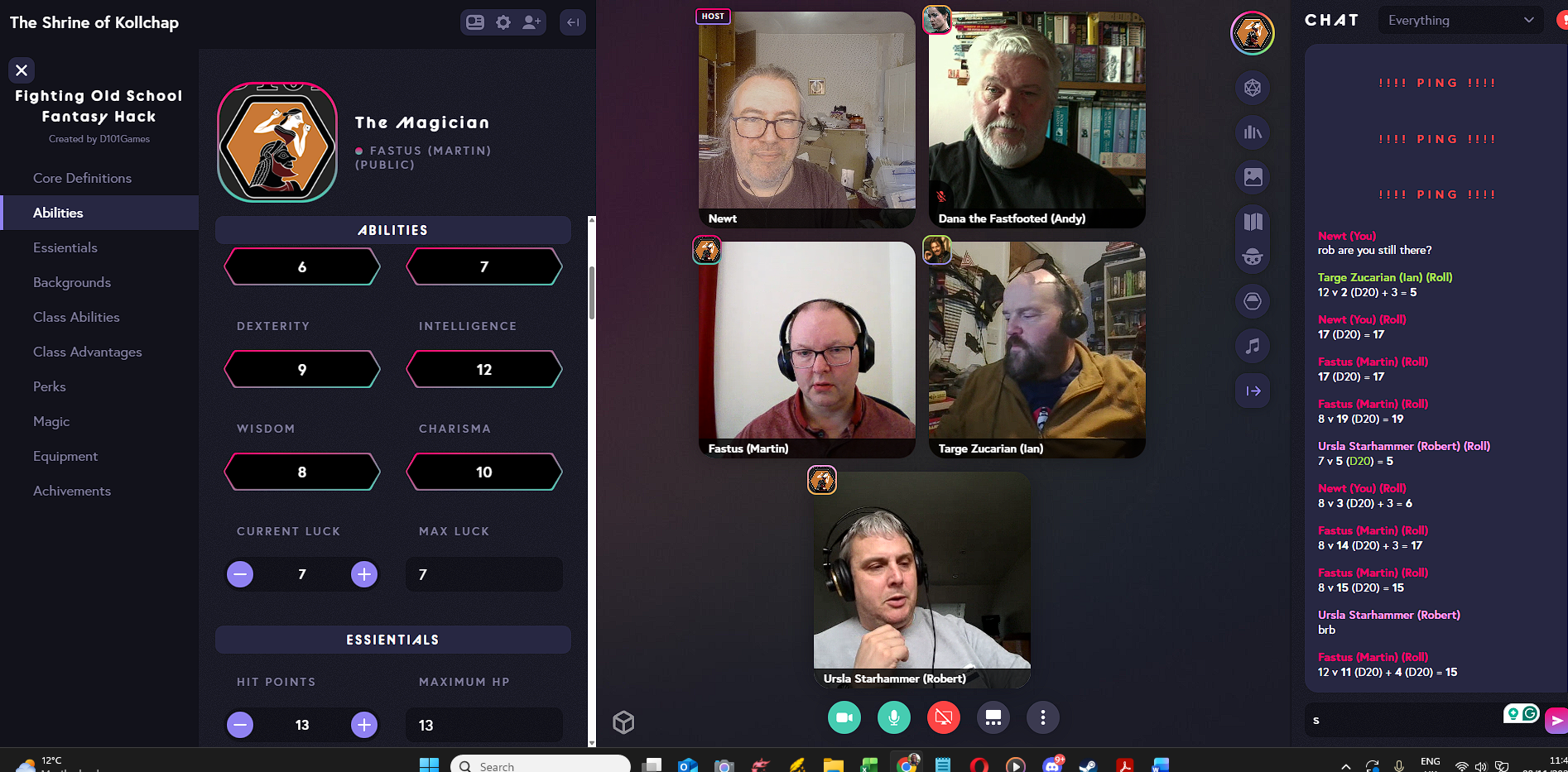
Here’s a picture of the game and its players (many thanks) , which was held over Role VTT.

Don’t Play this Adventure like D&D!

This is a boxed commentary for a Basic Roleplaying (BRP) adventure that I’m publishing in the first issue of Fantastic Odyssseys (eta: soon). It applies equally to other D100 Fantasy roleplaying games. It’s a bit ranty because I always get people saying that BRP fantasy games are just like D&D but with percentile skills. I think there’s a bit more to it than that 😉

If you are new to BRP and are using this to introduce yourself and your players to the system, bear the following in mind.

Roleplaying, backed up by skill and characteristic rolls, is important. Making alliances with non-player characters is important, and as well as gaining allies to help them in any big fight, is how the characters learn more about the backstory of Beacon Hill.

Characters are vulnerable. Even if you are using the optional Fate points system a lucky critical hit can easily take down even the most protected character. Encourage the players to think tactically, even if resorting to violence.

While violence is an option, some players will decide to play it overly cautious, even running away from confronting Yiddris and his undead cronies. This is acceptable, and successful completion of the adventure does not require the players to kill all the monsters and take their stuff. The write up even allows for this, giving multiple possible endings (see page xx).

Monsters are People too. The whole adventure twists on this. That the actual villains of the piece are the humans, and one sanctioned by the state carrying Royal Permits of Monster Hunting no less, who have disturbed the peaceful slumber of eternity of King Yiddris. And Yiddris is not merely a bunch of numbers, he’s got his motives and plans that depending on the player’s interactions with him will drive the adventure in one way or another (see Returning to Little Messing page xx).

More the characters do the more they will grow. The more the players push it and do things that trigger skill rolls, the more opportunities for character advancement via skill experience rolls at the end of the adventure.

Information management is a key area of focus for the GM. If the players dig and their characters successfully make the relevant Knowledge skill or Idea rolls, they will uncover more information than if they rely solely on surface-level first impressions. The GM should make them work for anything they learn and should resist the urge to hand out information as a big dump, no matter how fascinating it may be.

The adventure environment is dynamic and connected. The adventure locations are not isolated box rooms, where the inhabitants may occasionally pass each other in the corridors. Instead, the locations are interconnected; NPCs found in one area have relationships with NPCs in another and can move between them. You can use this to move the players along if they become obsessed with looking for clues or simply stuck because they don’t know what to do yet.

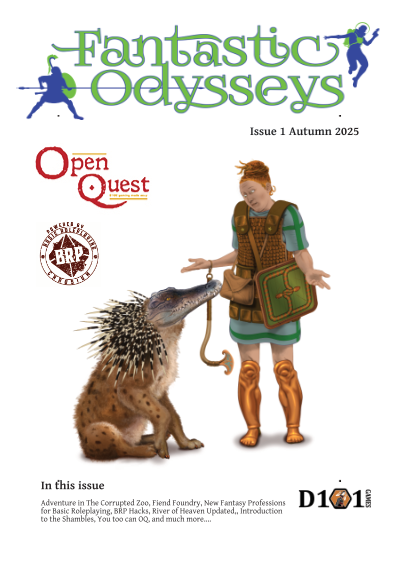
This, along with adventures, rules advice, and new monsters for OpenQuest, and an adventure, new fantasy professions and my house rules for BRP, is in issue one of Fantastic Odysseys, a magazine for D100 game systems available before Christmas.

Fantastic Odysseys issue 1 cover by Dan Barker

Wyrd Sword Playtest now Open

UPDATE 16/08/2025. I’ve now closed the application process, since I’ve got enough playtest GMs.Thanks to everyone who joined up.  I’ll be in touch early next week with the current draft of the rules, to get things started 🙂 

External playtest of Wyrd Sword, my BRP based fantasy game, is now open. I’m looking for GMs with groups to play the game and provide feedback. There’s a signup form here.

The basics of the game are as follows.

  • It’s my take on BRP fantasy using the Basic Roleplaying Universal Game Engine (BRUGE) as a base.
  • It starts with my experiences of RQ3 via the Games Workshop hardcover (equivalent of the RQ 3 Standard box) in the late 80s, before I lost myself in a decades-long Gloranthan campaign in the 90s.
  • The system is updated for modern sensibilities, while still being delightfully crunchy (Hit Locations, Fumble tables, special weapon effects are all in there).
  • It’s not tied to any specific setting, and there’s an assumed setting called the Realm, which you and your players develop the details of which as you go along (ie, discover through play).
  • Play is focused on the characters who are Champions of the Wyrd, a creative force that shapes the world and that has chosen them to defend it against the Agents of the Warp, an opposing primordial chaotic force from which the Wyrd weaves the world and which actively fights it to undo the order placed upon it. The characters are competent in their starting profession (of which there are 35), being around 50-75% in their primary skills.
  • It’s not a game of mythic fantasy or cosmic investigative horror. The game explores the character’s adventures through sandbox adventures, as they build up their own personal power and become legends in the Realm.

More about the game in detail, comparing it to BRUGE from which it was developed, in the following document.

There are also the following blog posts about the game in more detail.

Note: If your are an OpenQuest fan worried that I’m abandoning OQ for this, don’t. Legacy is very much a one off self-contained book, it should give you all the tools to run a very focused BRP fantasy game. Also, it’s a very different play experience, so while I’ve had a really fun time playtesting it, it’s in a way deepened my appreciation for the very different style and experience OpenQuest brings to the gaming table

Note II. This is the game I’ve been previously calling Legacy. When I opened the external playtest someone kindly pointed out that there was another game called Legacy, and futher research revealled there was at least two, with numerous games with names like Legacy of… or … Legacy. So a quick rename was in order.